

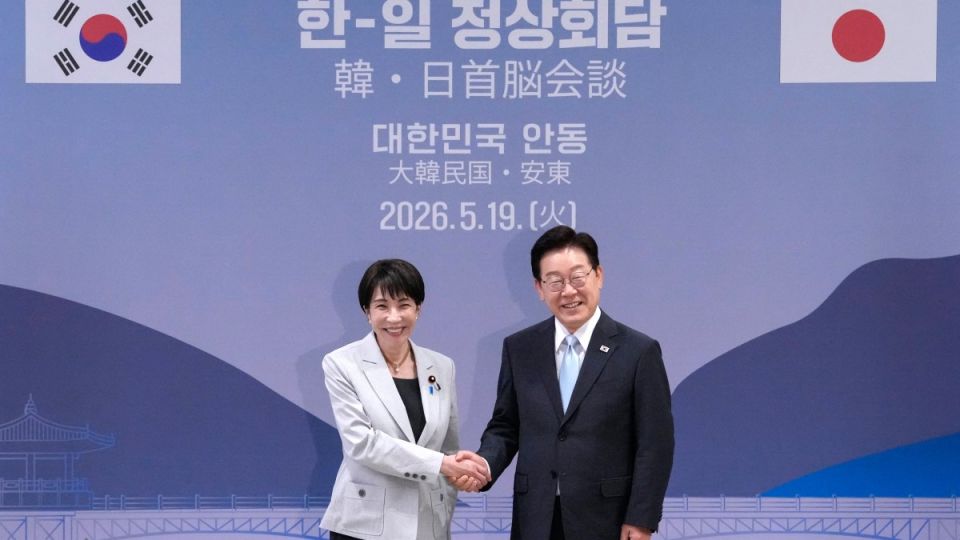
Seoul and Tokyo to expand LNG cooperation and deepen coordination on crude oil supply and stockpiling.
SEOUL – Seoul-Tokyo ties accelerated Tuesday as South Korean President Lee Jae Myung and Japanese Prime Minister Sanae Takaichi agreed to deepen energy and supply chain cooperation under shared pressure from the effective closure of the Strait of Hormuz.
Lee and Takaichi met in Lee’s hometown of Andong, North Gyeongsang Province, in a reciprocal trip following Lee’s visit to Takaichi’s home region of Nara Prefecture in mid-January.
The two-day visit marked the first exchange of hometown visits between sitting South Korean and Japanese leaders, a highly symbolic gesture reflecting growing trust and personal rapport. Takaichi’s visit also elevated what the two nations call “shuttle diplomacy,” the practice of reciprocal visits between the leaders of South Korea and Japan.
“At today’s summit, building on the trust developed through our shuttle diplomacy to date, Prime Minister Takaichi and I had candid discussions on a broad range of issues as strategic partners in jointly responding to the rapidly changing international environment,” Lee said during a joint conference following the summit.
The visit came at a moment of heightened strategic pressure for two neighbors whose ties have often been marked by deep-seated historical disputes over Japan’s 1910-45 colonial rule of Korea.
The war launched by the US and Israel against Iran on Feb. 28 has effectively closed the Strait of Hormuz, exposing the shared vulnerability of South Korea and Japan — two of the world’s most energy-import-dependent major economies — to disruptions in Middle Eastern energy flows.
“In particular, we agreed that close bilateral cooperation is needed more than ever amid the instability in supply chains and energy markets arising from the recent situation in the Middle East,” Lee told reporters. “We also concurred that peace and stability in the Middle East should be promptly restored.”
Lee underlined that “the two countries agreed to strengthen cooperation in the sectors of liquefied natural gas and crude oil, which are key energy sources.”
According to Lee, the two leaders agreed to “expand bilateral LNG cooperation while further strengthening channels for information sharing and communication regarding crude oil supply and stockpiling.”
Lee explained that the LNG cooperation is based on a memorandum of understanding on the optimization of LNG operations, signed in March between Korea Gas Corp. and Japan’s JERA. The agreement includes LNG swaps and aims to enable a joint response to supply crises while refraining from actions that could negatively affect each other’s supply chains.
The agreement reflects a shared reality: South Korea and Japan both have major petrochemical and refining industries, remain heavily dependent on Middle Eastern crude imports and are among the world’s largest LNG importers. The two are also closely interconnected through energy trade.
According to the Korea Petroleum Association, Japan was South Korea’s third-largest destination for petroleum-product exports last year, accounting for 11.3 percent.
Japan and South Korea were also the world’s second- and third-largest LNG importers in 2024, accounting for 16.47 percent and 11.43 percent of global LNG imports, respectively, according to the International Gas Union’s 2025 report.
Speaking at a joint news conference, Lee also unveiled plans for South Korea to join Japan’s “POWERR Asia” initiative — short for Partnership on Wide Energy and Resources Resilience.
Japan’s initiative aims to strengthen cooperation with Southeast Asian countries in areas such as the construction and shared use of petroleum storage facilities, backed by $10 billion in financial support, including loans and credit assistance through institutions such as the Japan Bank for International Cooperation.
“Prime Minister Takaichi also proposed that our two countries work closely together to deepen cooperation on resource supply chains with other Asian nations facing supply disruptions,” Lee said. “I welcomed the initiative and conveyed my commitment to actively participating in it.”
Takaichi unveiled the initiative for Southeast Asian nations at the virtual Asia Zero-Emission Community Plus virtual summit in April, where South Korean Prime Minister Kim Min-seok attended the summit on behalf of Seoul.
Speaking at the news conference, Takaichi said she welcomed the agreement with Lee to launch cooperation under the “POWERR Asia” initiative, with a focus on “strengthening energy supply resilience in the Indo-Pacific region, including expanded stockpiling capacity.”
Takaichi underscored that the two sides would also work to enhance “Korea-Japan energy security through mutual supply arrangements and swap transactions involving crude oil, petroleum products and LNG,” adding that Seoul and Tokyo would “jointly explore concrete follow-up measures.”
Lee and Takaichi also reaffirmed the importance of Korea-Japan and trilateral Korea-US-Japan cooperation for regional peace and stability amid rapidly shifting geopolitical conditions, while welcoming the recent upgrade of bilateral security policy talks to the vice ministerial level.
The two leaders exchanged views on the Korean Peninsula, with Lee emphasizing his government’s vision of building “a peaceful Korean Peninsula where the two Koreas can coexist peacefully and grow together — one where there is no need to fight.”
Lee said he and Takaichi also agreed to expand future-oriented cooperation in areas including AI, space, biotechnology and transnational crime response.
Lee also noted that the two countries had agreed on procedures for DNA analysis of remains recovered from Japan’s Josei coal mine, where a 1942 flooding disaster killed 183 workers, including 136 forcibly mobilized Koreans.
“This will be a small but meaningful first step for both countries in cooperating on historical issues, starting with humanitarian matters,” Lee said.
“Going forward, the possibilities for Korea-Japan partnership are limitless.”
ANN/The Korea Herald