

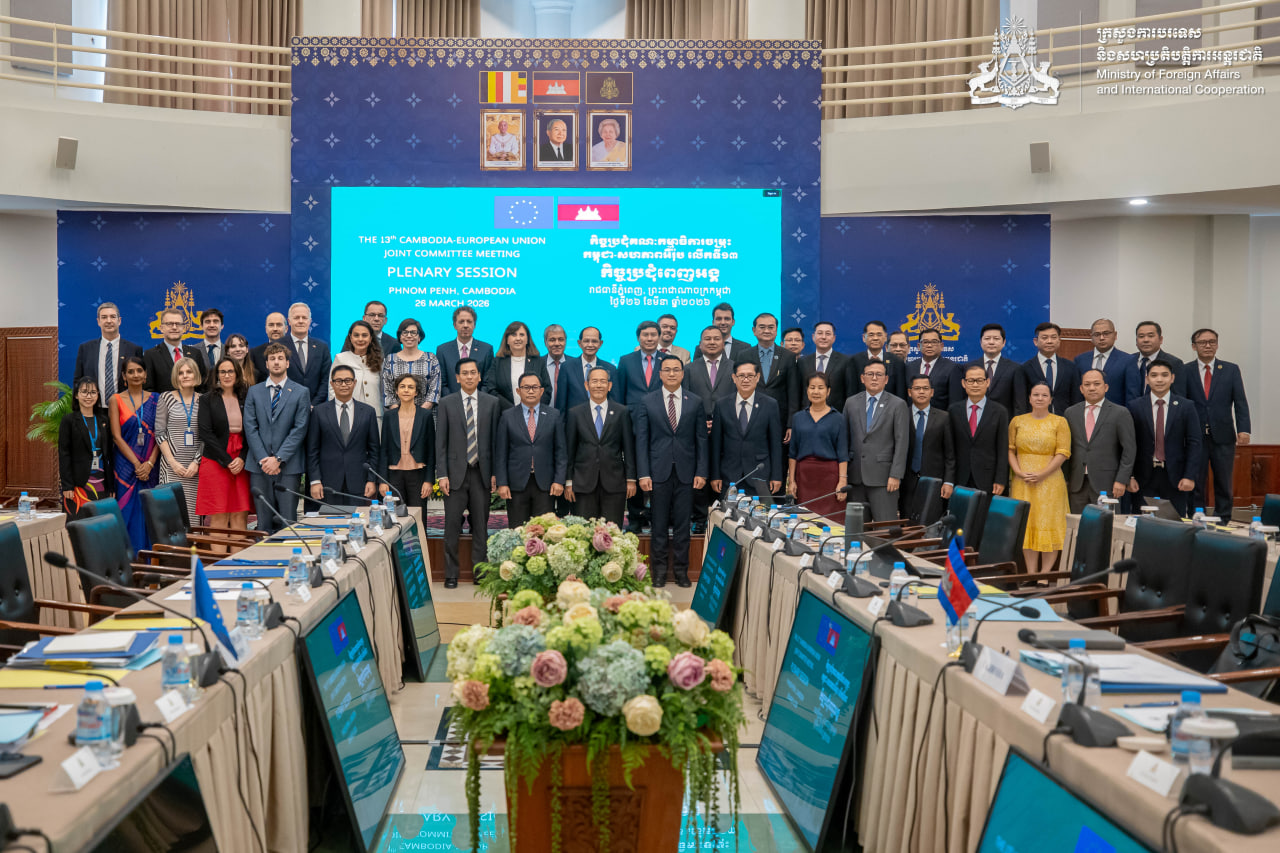
Relations between Cambodia and the EU are expected to further improve following the 13th EU-Cambodia Joint Committee Meeting. During the March 26 event, both sides agreed to promote deeper cooperation in trade, investment, institutional capacity building, governance and human rights.
According to an April 3 joint press release from Cambodia’s Ministry of Foreign Affairs and International Cooperation and the EU, the meeting followed three subgroup discussions (24-25 March) on Cooperation, Trade and Investment, and Institution Building, Governance, and Human Rights, reinforcing the long- standing partnership between the EU and Cambodia.
The Joint Committee was co-chaired by foreign ministry secretary of state Kan Pharidh and Paola Pampaloni, deputy managing director for Asia and the Pacific of the European External Action Service.
During the meeting, The EU and Cambodia
Both sides reaffirmed the alignment between phase one of Cambodia’s Pentagonal Strategy and the EU’s Global Gateway Strategy. They remained committed to mobilising investments in quality infrastructure under Global Gateway and Team Europe, particularly in the energy and clean water sectors.
Discussions highlighted the successful implementation of two Global Gateway Flagships, namely the Bakheng Water Treatment Plant and the Partnership in Education for Green and Digital Jobs.
The EU and Cambodia underscored the importance of supporting public finance management reforms, trade and private sector development, as well as Cambodia’s transition from the Least Developed Countries (LDC) status through export diversification and value-chain development. EU-ASEAN cooperation also remains key to address migration challenges and support Cambodia’s transition towards a sustainable future, it noted.
To this end, Cambodia and the EU committed to enhancing investment coordination and engaging European businesses, solidifying their shared vision for a prosperous, sustainable future.
Bilateral trade and investment relations were discussed, including Cambodia’s trade preferences under the EU’s Generalised Scheme of Preferences (GSP) and its future transition from the Everything But Arms (EBA), improving the investment climate and the ease of doing business for EU companies to attract greater investments. Discussions covered regional economic integration, with updates on ASEAN trade agreements and developments in the World Trade Organization (WTO).
According to the EU, in 2025, EU-Cambodia bilateral trade in goods reached €7.2 billion, underscoring the importance of sustained economic engagement.
“The EU and Cambodia engaged in a candid and constructive dialogue on human rights, including civil and political rights, freedom of expression, and media freedom, labour rights and business accountability, rule of law and justice reforms, in line with international conventions ratified by Cambodia. They also discussed gender equality, minority rights and combating human trafficking and online scamming,” noted the release.
“While acknowledging significant divergences in their respective assessments of the human rights situation of Cambodia, both sides reiterated their commitment to the international human rights law and agreed to continue with the dialogue,” it said.
It was agreed that the 14th committee and its subgroup meetings would be held in Brussels.