

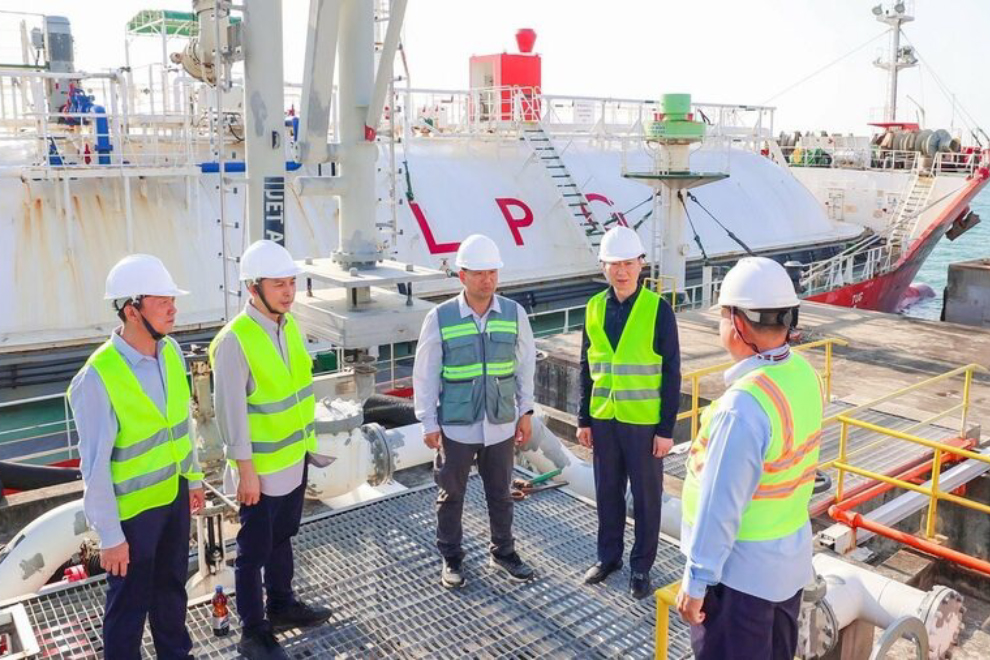
Minister of Mines and Energy Keo Rottanak has explained how the government is working to secure energy supplies, especially of LPG, amid ongoing tension in the Middle East. He called for the public to be mindful when using existing resources.
Rottanak visited Sihanoukvile Autonomous Port (PAS) today, March 30, where he welcomed the arrival of a ship transporting 3,400 tonnes of LGP purchased by the Tela Khmer company, as well as the arrival of gasoline and diesel for Caltex.
As the US and Israel war on Iran continues, the closure of the Strait of Hormuz has affected the entire world. Asia has been hit particularly hard as more than 84% of the region’s oil and gas must pass through the strait.
“When that passage has problems, it becomes a challenge for all of Asia. Today, as you can see, a ship has brought a fresh shipment of LPG to Cambodia,” said Rottanak, as the vessel arrived.
“Finding sources — whether it is gasoline, diesel or LPG — is competitive because there are shortages everywhere. It’s not just a matter of having money to go and buy or order; in these difficult circumstances, even if you have money and place an order, the products might not be available for us. The two tightest products are, first, diesel, which is scarce, but what is even tighter than diesel for Cambodia is the issue of LPG gas,” he explained.
He noted that Vietnam, Bangladesh, Sri Lanka and India are all facing a similar issue.
According to the minister, Tela normally secure eight LPG deliveries per month, but are only able to guarantee four or five at the current time.
“Therefore, the government urges everyone to use fuel and gas with great care and thriftiness. Today is another confirmation that the Royal Government is working with all major partners, both local and international, to ensure that we still have fuel and gas supplied to our country,” he said.
According to Rottanak, the two Caltex ships that docked today brought 12 million litres of diesel and more than 14 million litres of gasoline.
“So, you can have an idea of the quantities involved. What I want to emphasise is that the government’s leadership in this difficult situation is about doing whatever it takes to help all partners bring this fuel in by simplifying all administrative procedures, lowering all types of taxes and duties to ease the cost of the fuel we receive so that the price for society does not become too high,” he said.
He repeated calls for people to conserve fuel as much as possible.
“First, to save your own money, and second, to avoid reaching a point where everyone is scrambling to buy. If we continue to manage as we have been, we can overcome these difficulties,” he said.