

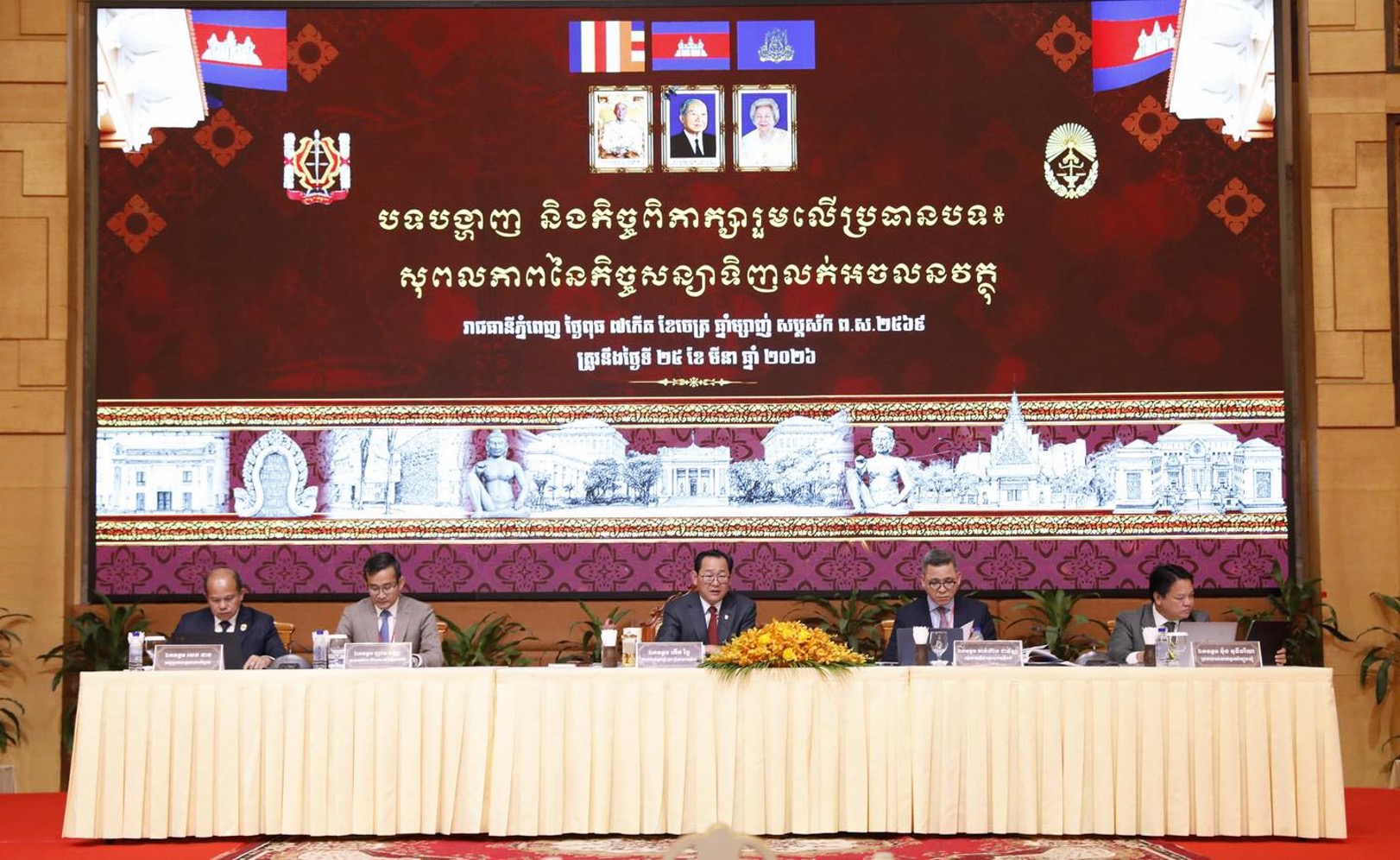
The Kingdom’s judiciary held its annual general assembly earlier this week, to review the results of its 2025 activities and plan for the coming year.
A resolution released on March 27 described the assembly’s pride in last year’s work, highlighting the judiciary’s critical role in Cambodia’s ongoing fight against online criminal fraud.
It described the work of 2025 as “contributing significantly to enhancing the quality and efficiency of justice services, as well as promoting transparency, integrity and accuracy in law enforcement and court proceedings”.
The agenda included three main topics: the validity of real estate purchase agreements, challenges in forced execution cases and the disciplinary framework for judges, however the assembly chose to focus on making online scam cases a priority for the court system, in order to accelerate legal proceedings.
The day before the release of the general assembly’s resolution, the UK government issued a fresh round of sanctions against individuals linked to what it described as “Cambodia’s largest scam centre”, known as “8 Park”.
The British government noted that following previous UK actions, the Cambodian government launched a large-scale crackdown on the scam economy.
“Today’s sanctions support the actions being taken by Cambodia and other countries in the region,” it said.
Legend Innovation Co, the operator of 8 Park, and its director Eang Soklim, were sanctioned, along with two other men who were linked to the large-scale operations of Prince Group, owned by the Chen Zhi, who was deported to Chona where he is now facing charges related to online crimes on a massive scale.
Thet Li was sanctioned for his role in managing the Prince Group’s financial networks, including in Taiwan. Hu Xiaowei, a long-term associate of Zhi, who has been unmasked as involved in the Prince Group’s financial network under 3 different aliases, was also sanctioned.
The UK also sanctioned Xinbi, a Chinese-language online marketplace that it claims enable the operation of scam centres in Southeast Asia by offering cryptocurrency-based services. It is one of the largest such marketplaces and according to the UK, has facilitated the laundering of stolen crypto assets by North Korea.
The general assembly’s resolution warned that “Online crimes not only severely affect security and public order but also seriously damage Cambodia’s reputation, image and dignity on the international stage”
“They also have a major negative impact on tourism, investment and Cambodia’s economic sector,” it added.
It noted that the government recognises the gravity of the impact on national society caused by technological crimes and the complexity of modern-day scamming. Consequently, it claimed to have taken measures to combat these crimes by making them a high priority on its political agenda.
To support the government’s commitment to stamping out these crimes, the assembly has designated cases related to technological scams as a priority for courts and prosecution offices at all levels, urging close attention to strengthening law enforcement.
The resolution highlighted the judiciary’s commitment to integrity and responsibility while dealing with technological crimes and money laundering.
Since the middle of last year, Cambodia has increased pressure on online scam operations, partly because neighbouring Thailand used the pretext of the crimes to infringe upon Cambodian sovereignty. As a result of the government’s efforts, nearly 700 perpetrators have been sentenced, with thousands more deported.