

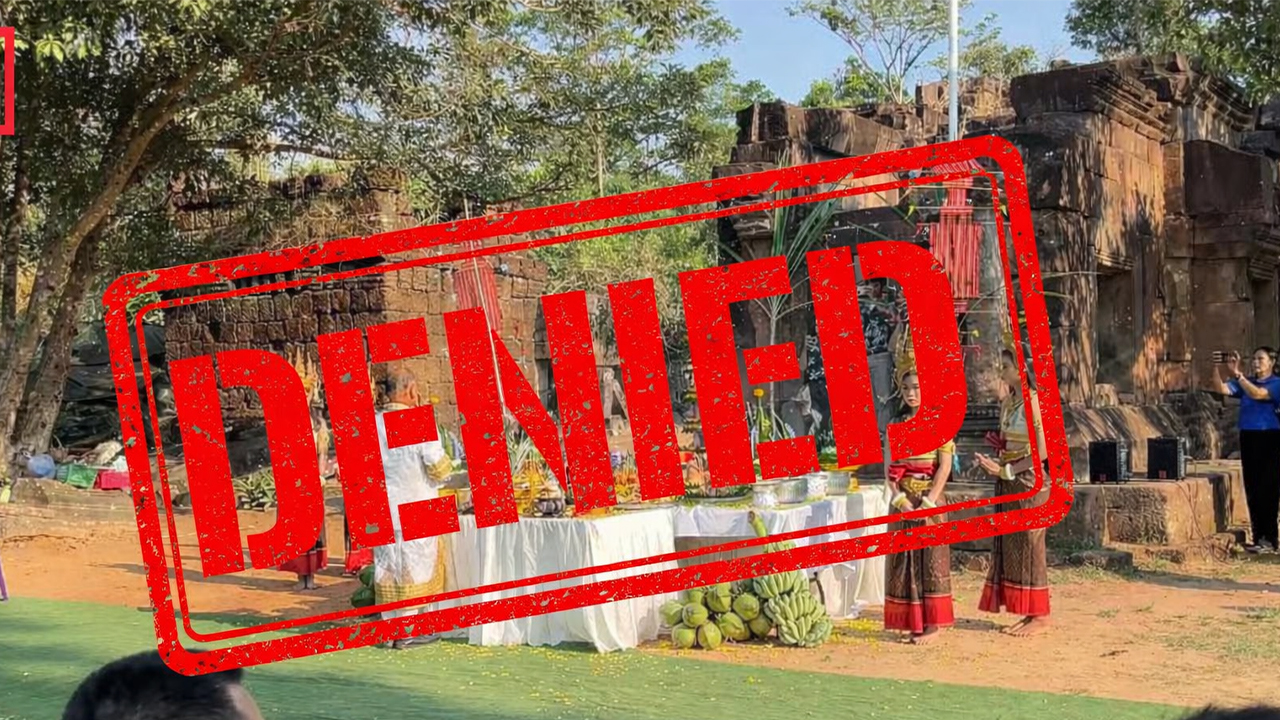
The announcement that Thai authorities have announced public tours of several of the Cambodian temples that it currently occupies has drawn widespread protests.
The Ministry of Culture and Fine Arts warned that the staging of activities at these cultural heritage sites is worsening tensions and undermining Cambodia’s territorial sovereignty.
In statement released late on April 13, the ministry expressed grave concerns over what it described as “the continued facilitation of tourism and public gatherings by Thai authorities at several temples, including Tamone Thom, Ta Krabey Temple and K’Nar Temple, all of which were occupied by Thai forces in the armed clashes of late December.
The ministry said such activities go beyond a mere presence on the ground, arguing that organised visits, public events and site promotions amount to an assertion of administrative control.
“These actions represent an unlawful exercise of jurisdiction over Cambodian territory,” the statement said, warning that they risk creating a false impression of ownership and control.
The ministry stressed that the situation is particularly sensitive given the cultural and historical significance of the sites, which are considered part of Cambodia’s national heritage.
It cautioned that increased public engagement at the locations could complicate future negotiations and escalate tensions along the border.
The statement also highlighted concerns that these activities, combined with infrastructure development such as roads and installations, may be seen as attempts to solidify claims on the ground.
Cambodia argued that such moves contradict existing agreements and international legal frameworks governing the boundary between the two countries.
Citing instruments including the Franco-Siamese Treaty of 1907 and principles under the UN Charter, the ministry said the actions could be interpreted as violations of Cambodia’s sovereignty and territorial integrity.
Cambodia called on the Thai government to halt the public tours immediately and withdraw all personnel involved, urging respect for established legal mechanisms.
It reiterated its commitment to resolving the dispute peacefully through bilateral channels, particularly the Joint Boundary Commission.
This latest development signals a shift in focus from purely military or administrative concerns to the broader implications of public engagement in disputed areas, highlighting the growing complexity of the Cambodia–Thailand border issue as both sides navigate historical claims and national sensitivities.