

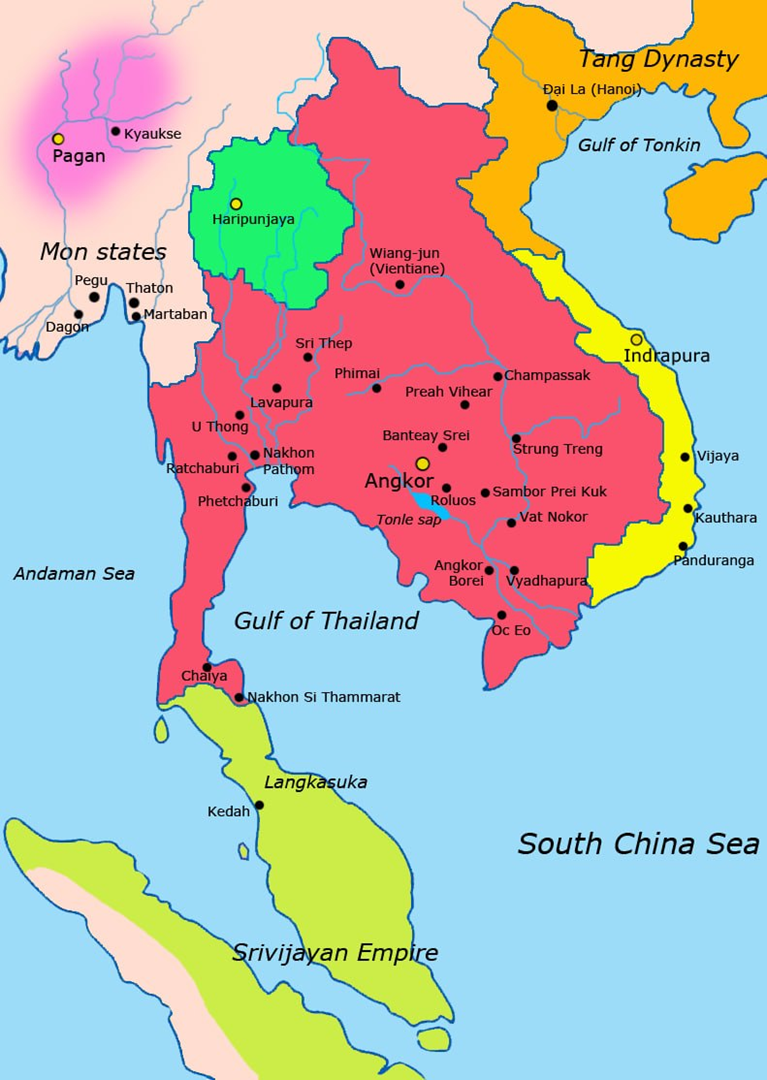
The tensions that occasionally arise between Cambodia and Thailand are often portrayed as modern political disagreements. However, a deeper examination reveals a far more complex reality — one rooted in centuries of history, power struggles, cultural transmission and unresolved colonial legacies. This enduring issue can be best understood as a heritage conflict, where the past continues to shape the present.
To fully understand this conflict, one must go back to the height of the Angkor Empire, when Cambodia was the dominant civilisation in mainland Southeast Asia. During this period, the Khmer Empire was not only a political and military power but also a cultural and intellectual centre that influenced neighbouring regions.
The Khmer civilisation developed advanced systems of governance, religion, architecture, language and art. Elements of Hinduism and later Theravada Buddhism, monumental temple architecture, court rituals, classical dance and aspects of written language were part of a sophisticated cultural framework that extended beyond its borders. As Khmer influence expanded, these cultural elements were gradually transmitted to emerging societies in the region, including early Thai polities such as the Sukhothai and later Ayutthaya kingdoms.
Historical evidence suggests that many aspects of court culture, religious practices and state organization in these early Thai kingdoms were adapted from earlier Khmer models. This was not unusual for the time; cultural exchange and adaptation were common across Southeast Asia. However, over centuries, as these societies developed their own identities, these shared cultural roots became less visible and more contested.
Following the decline of Angkor, Cambodia entered a prolonged period of political instability. By the late eighteenth century, during the reign of Ang Eng I, the Kingdom was significantly weakened. It became caught between the expanding powers of Siam and Vietnam, with its sovereignty increasingly compromised. Cambodian rulers often depended on foreign support, leading to the gradual loss of territorial control, particularly in the northwest.
Regions such as Battambang and Siem Reap fell under Siamese administration — not necessarily through voluntary cession, but as a result of political necessity and imbalance of power. These developments laid the groundwork for long-standing territorial disputes and differing historical narratives between the two nations.
The arrival of France in the nineteenth century marked another turning point. In 1863, Cambodia became a French protectorate under King Norodom I. French authorities sought to stabilise the region but did so by imposing borders based on treaties and maps that often overlooked the complexity of local history.
In 1907, France negotiated the return of key territories from Siam to Cambodia. Yet, while these agreements restored certain lands, they also formalised borders that would later become sources of dispute. These colonial boundaries did not fully resolve competing historical claims, leaving behind ambiguities that persist to this day.
One of the most prominent examples is the dispute over Preah Vihear Temple. This ancient Khmer temple, located along the modern border, became a symbol of both historical pride and political tension. Cambodia based its claim on historical continuity and colonial-era maps, while Thailand emphasised geographic proximity. The case was ultimately decided by the International Court of Justice in 1962 in favour of Cambodia, with a reaffirmation in 2013. Despite these rulings, tensions have periodically resurfaced.
Beyond territory, the conflict extends into cultural identity. The shared traditions between Cambodia and Thailand — such as New Year celebrations, religious customs, classical arts and architectural styles — reflect a long history of cultural exchange rooted in the influence of the Khmer Empire. Yet, in the modern era, these shared elements have sometimes become points of contention, with each nation seeking to define and protect its national identity.
Today, relations between Cambodia and Thailand remain largely stable at the diplomatic level, but sensitivities persist. Historical narratives, cultural ownership and border interpretations continue to influence public discourse. What remains is not open conflict, but a deeply embedded historical tension shaped by memory, identity and interpretation.
Ultimately, the heritage conflict between Cambodia and Thailand is the result of layered history: the cultural influence of the Angkor Empire across the region, the political decline during the time of Ang Eng I, territorial pressures from neighbouring powers, the intervention of France and the rise of modern nationalism.
Understanding this shared past is essential — not to assign blame, but to recognise that both nations are deeply connected through history. What is often seen as conflict may also be understood as a reflection of intertwined heritage, shaped over centuries and carried into the present.
Tesh Chanthorn is a Cambodian citizen who longs for peace. The views and opinions expressed are his own.