

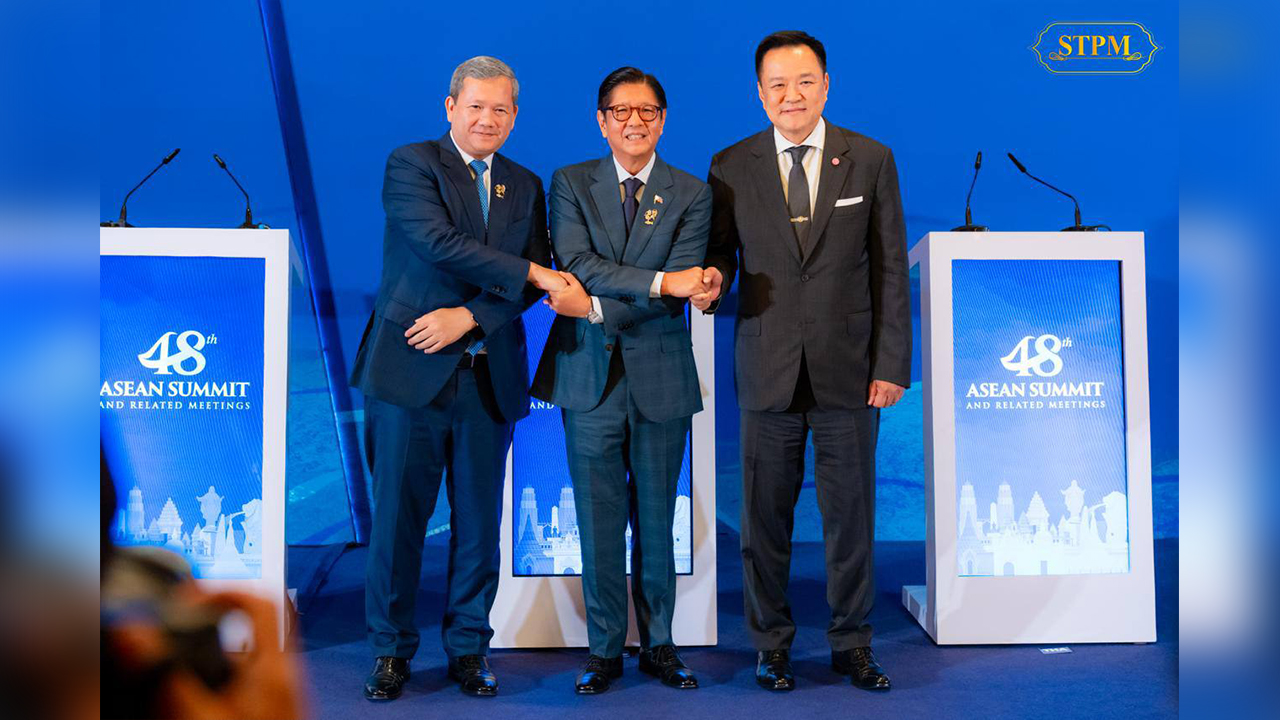
Cambodian Prime Minister Hun Manet reaffirmed that border disputes with Thailand must be resolved through existing bilateral mechanisms and international law, rejecting what Phnom Penh described as “fait accompli on the ground” during May 7 ASEAN Chair-mediated talks with Thai Prime Minister Anutin Charnvirakul.
The meeting, held on the sidelines of the 48th ASEAN Summit in Cebu, Philippines, was facilitated by Philippine President Ferdinand Marcos Jr. amid continuing tensions over disputed land and maritime boundaries between Cambodia and Thailand.
It marked the first meeting between Hun Manet and Anutin since October last year, two months before deadly clashes broke out along parts of the Cambodia-Thailand border in December.
Addressing he media immediately after the discussions, Manet stressed that Cambodia would not accept any attempt to alter borders through force or unilateral actions on the ground.
“Cambodia reiterates that border cannot be changed or determined by force or through fait accompli,” he said.
The Cambodian premier called for the “full and immediate implementation” of the joint statement agreed on Dec. 27, 2025, particularly the provisions requiring border demarcation work to proceed through the existing Joint Boundary Commission (JBC) mechanism, without further delay.
Manet explained that the JBC remained the essential framework for resolving border disputes and ensuring practical implementation of agreements reached by both sides.
“Cambodia believes that this mechanism will be essential to ensure even and practical effective implementation,” he said.
He also reflected on the role of the ASEAN Observer Team (AOT), thanking ASEAN member states for supporting monitoring efforts along the border and welcoming the Philippines’ leadership role after taking over coordination responsibilities from Malaysia.
He called for a strengthened mandate for the observer mission to “verify and ensure the implementation of specified and all agreed measures”.
Beyond land disputes, Manet noted that Cambodia and Thailand also discussed overlapping maritime claims in the Gulf of Thailand, with Phnom Penh reaffirming its intention to pursue peaceful settlement mechanisms based on international law.
Cambodia recently announced plans to initiate compulsory conciliation proceedings under the UN Convention on the Law of the Sea (UNCLOS) following Thailand’s withdrawal from a 2001 Memorandum of Understanding governing maritime negotiations.
“Cambodia remains firmly committed to peaceful settlement of disputes based on international law and existing agreements,” Manet said.
Marcos, who mediated the talks as ASEAN chair, said the discussions demonstrated the bloc’s commitment to dialogue, restraint and peaceful settlement of disputes.
“There were many candid discussions about the border situation between Cambodia and Thailand,” Marcos said.
“Both reaffirmed the importance of maintaining open communication, exercising restraint, avoiding actions that may escalate tensions, and continuing efforts towards peaceful dialogue and constructive engagement,” he added.
Marcos said both leaders had agreed to instruct their foreign ministers to sustain direct discussions and develop practical approaches aimed at preventing further escalation and rebuilding trust.
He also confirmed that the ASEAN Observer Team’s mandate had been extended for another three months until July.
“The Philippines commits to continue offering its good offices to enable both countries to engage in sustained dialogue and cooperation,” Marcos said.
The Thai prime minister said both sides had held “frank and candid” discussions and agreed that dialogue remained the only viable path forward.
“Thailand and Cambodia are two neighbouring countries. It is best that we avoid conflict. It only brings losses and suffering,” he said.
Anutin agreed that the two countries would task their foreign ministers with developing practical confidence-building measures that could be implemented immediately to restore trust and gradually rebuild bilateral relations.
“Thailand and Cambodia must move forward together step by step in the same direction,” he said.
“Today we have taken a major step. I am confident that with resolve, determination and sincerity on both sides, we can advance the pursuit of peace for our two countries and for the region as a whole,” he noted.
Despite the diplomatic engagement, tensions remain unresolved over several contested border areas where Cambodian officials say Thai troops continue occupying Cambodian territory.
The latest round of talks comes as ASEAN seeks to prevent further deterioration in relations between the two neighbours, with regional leaders increasingly concerned that prolonged tensions could undermine stability and unity within the bloc.