

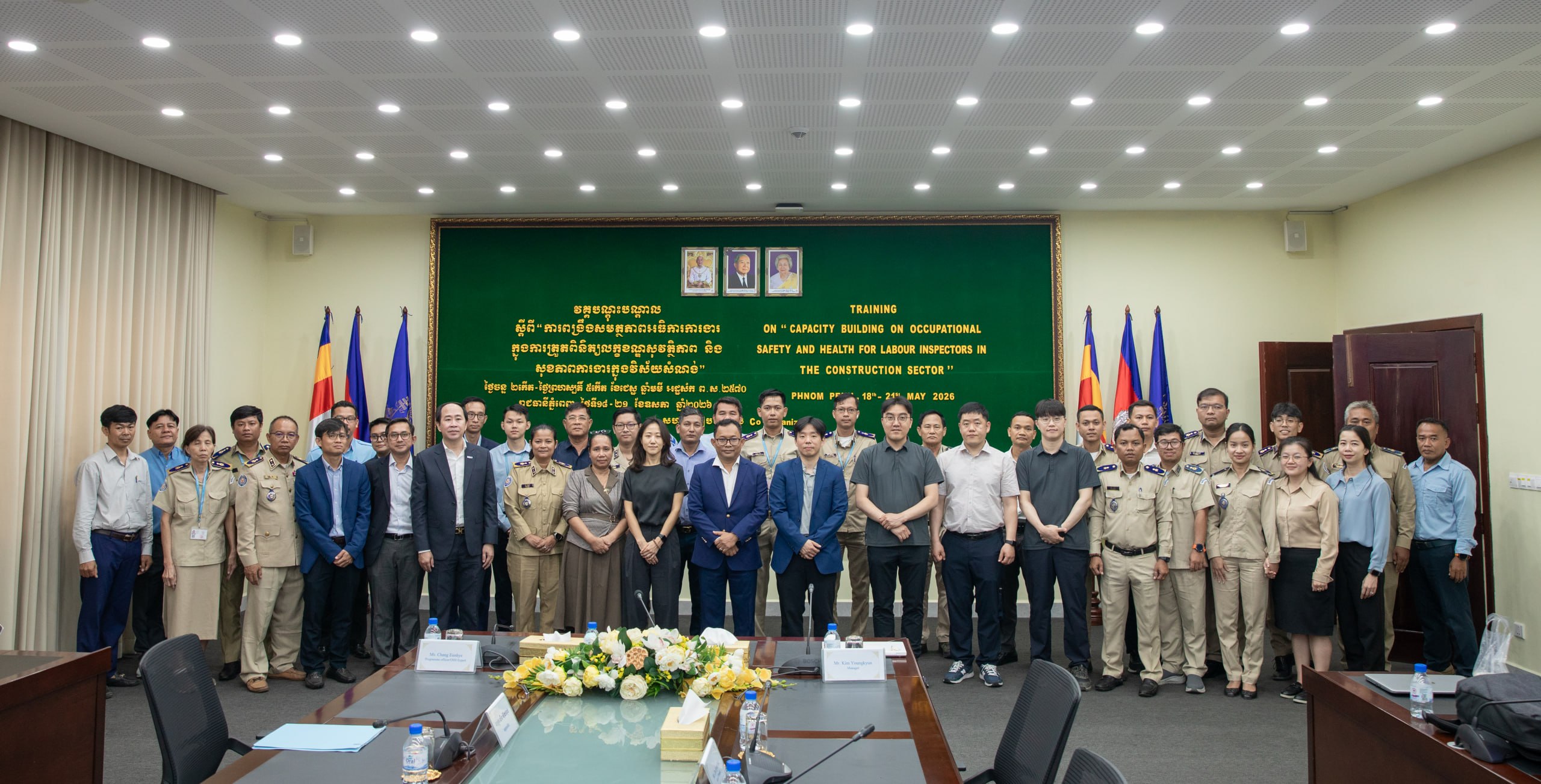
ILO (International Labour Organization) / Korea Partnership Programme, in collaboration with the Ministry of Labour and Vocational Training (MLVT), is providing a four-day training course to 32 Occupational Safety and Health (OSH) inspection officials for the construction sector.
The goal is to strengthen the OSH inspection knowledge and skills of officials and the designated labour inspectors responsible for OSH in Cambodia’s construction sector.
The 32 participants are broadly divided into three main groups representing central, provincial, and inspection authorities: 15 central-level officials from the ministry’s Department of Occupational Safety and Health (DOSH), 15 provincial labour inspectors from Provincial Departments of Labour and Vocational Training, and 2 from the Department of Labour Inspection (DLI). All were selected based on their demonstrated engagement in OSH inspection duties and supervisory capacity.
The training, delivered by the Korea Occupational Safety and Health Agency (KOSHA), kicked off on May 18 and will conclude on May 21. The sessions are being held at the labour ministry headquarters and the Occupational Safety and Health Training Centre (OSHTC), and will also include at least two on-site visits to active construction sites.
The training will enhance officials’ practical inspection skills in major construction hazard areas, including temporary structures, fall prevention, crane and lifting equipment, earth retaining and formwork, construction machinery and site inspection techniques.
The ministry and ILO have identified a gap in OSH inspection knowledge and skills — including hazard recognition, risk assessment, and enforcement techniques for construction sites—which limits the effectiveness of inspections and the promotion of a preventive safety and health culture.
The training addresses ongoing challenges in Cambodia’s construction sector continues to present unique and evolving challenges in Cambodia. Factors such as a large informal workforce, complex multi-employer worksites and increasing exposure to climate-related hazards like extreme heat all demand increasingly specialised inspection competencies.
Labour ministry secretary of state Som Chamnan said at the launch of the training that the construction sector in Cambodia is thriving but requires a focus on Occupational Safety and Health to ensure that not only the construction projects themselves are safe, but also the workers.
“The safety and health of workers reflects Cambodia’s reputation as well, because this sector is a global focus, not just a focus of the Cambodian government. That’s why the International Labour Organization has included core international conventions in addition to eight others already in place. The two most recent conventions are related to the safety and health of workers,” he said.
“All of the participants are inspection officials tasked with inspecting various aspects of enterprises. In the construction sector, they also check occupational safety and health at construction sites. Thus, this training equips them with the knowledge and skills to ensure their inspections are effective and their evaluations are accurate,” he added.
Chang Eunhye, a program officer of the ILO/Korea Partnership Programme, noted that the labour ministry pays close attention to OSH. With Cambodia set to adopt an OSH Act in the near future, this first phase of training is crucial, especially for gaining hands-on experience.
“KOSHA is well-known for its expertise in construction sector inspections. Therefore, we are sharing these experiences with trainees to support their capacity building,” she said.
Lung Chim, Deputy Chief of the Inspection and Labour Dispute Office under the Labour and Vocational Training Department in Kampong Speu Province, had high expectations for the training.
“Following this four-day training, we expect to gain significant knowledge regarding OSH in the construction sector. We will apply this knowledge and these skills and share them widely with factories and enterprises, especially at construction sites, to ensure they have safety and health systems in place.
“We do not want to see any danger arising from complacency,” he added.