

Cambodia is entering a decisive economic transition where low-cost labour alone will no longer be enough to sustain growth, as policymakers and investors confront the reality of rising global competition, tighter trade conditions and the approaching end of Least Developed Country (LDC) trade preferences.
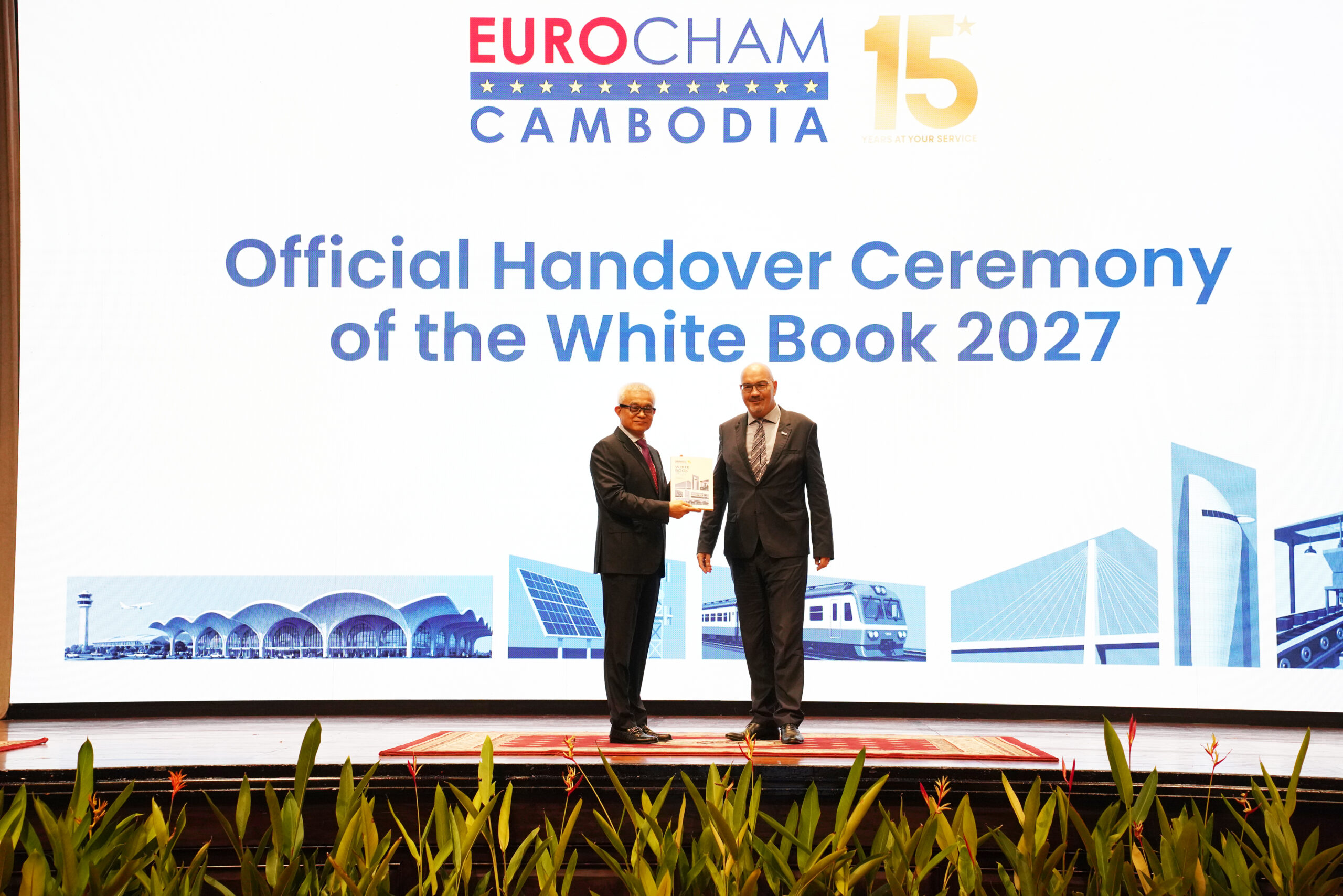
That message came through clearly at the launch of the EuroCham Cambodia White Book 2027 on May 19 at the Sofitel Phnom Penh Phokeethra, with senior government officials, diplomats and business leaders gathering to assess the progress of the Kingdom’s reforms and future competitiveness.
Opening the event, Minister of Economic and Finance Aun Pornmoniroth set the tone from the government side, underscoring Cambodia’s commitment to maintaining macroeconomic stability while continuing to improve the investment climate and strengthen public-private cooperation as the country moves toward a more advanced stage of development.
His remarks reflected a broader policy direction: Cambodia is no longer competing only on wages, but increasingly on efficiency, governance quality and institutional readiness as it prepares for structural shifts linked to LDC graduation in 2029 and the end of transition arrangements in 2032.
“Over the years, the White Book has been instrumental in driving many key reforms in Cambodia. This document is not merely a publication, but a testament to the strength of the close public-private partnerships in achieving a shared vision of sustainable, inclusive and resilient development,” he said.
He explained that it provides an “investor’s perspective”, allowing the government to fine-tune policies, ensuring Cambodia remains a “competitive and attractive investment destination in the region”.
From the private sector side, EuroCham Cambodia chairman Tassilo Brinzer warned that the global environment is becoming more volatile, with geopolitical tensions, trade fragmentation and supply chain realignment reshaping investment decisions across Asia.
“We must move decisively to defend the global economy and the investment climate,” Brinzer said, pointing to increasing uncertainty for international investors and the need for predictable regulatory systems.
The EuroCham White Book 2027 outlines 77 policy recommendations across 12 sectors aimed at improving Cambodia’s business environment, with a strong focus on logistics efficiency, digital governance and regulatory simplification.
At its core, the report frames Cambodia as entering a “transformative economic phase” in which competitiveness will depend less on cost advantages and more on productivity, speed and institutional reliability.
“As the Kingdom approaches graduation towards middle income country status, the economic landscape is evolving rapidly too,” the report notes, highlighting the urgency of structural upgrading.
A shifting growth model
For decades, Cambodia’s export-driven growth model relied heavily on low labour costs, preferential trade access and labour-intensive manufacturing, particularly in garments, footwear and travel goods.
But EuroCham argues that this model is reaching its limits. With LDC benefits gradually phasing out, Cambodia will need to compete more directly with regional manufacturing and logistics hubs such as Vietnam, Thailand and Indonesia, where infrastructure and supply chain systems are more advanced.
The White Book warns that Cambodia’s competitiveness will increasingly depend on how quickly it can modernise logistics systems, reduce administrative barriers and improve coordination between government institutions.
EuroCham executive director Martin Brisson said the recommendations reflect real operational bottlenecks faced by companies on the ground.
“These members gather through committees… bringing the issues from the ground and creating this common and collective voice that we bring to decision-makers,” he said.
Progress is real — but uneven
Despite concerns, both government and business leaders acknowledged that Cambodia has made measurable progress in recent years.
The White Book 2027 highlights several reforms, including the commercial rollout of 5G services in January 2026, the introduction of a Digital Skills Development Roadmap, tax audit improvements and the establishment of a green financing facility for SMEs.
The report also points to the government’s Renewable Energy Certification scheme launched in April 2026, which aims to support exporters responding to stricter environmental requirements from international buyers.
Other reforms include progress in customs procedures, clearer labour regulations, asbestos bans in construction materials and improvements in pharmaceutical registration processes.
These developments suggest Cambodia is actively building the institutional foundations required for a more diversified and higher-value economy.
The red tape problem
However, the most persistent concern raised by EuroCham is not the absence of reform — but the pace and consistency of implementation.
A central theme of the White Book is the continued presence of administrative “red tape”, defined as complex or repetitive procedures that slow investment and trade processes.
Despite digitalisation efforts, businesses report that many procedures remain fragmented across ministries and still require manual verification or repeated document submission.
One of the most cited examples is the overlap between Cambodia’s Qualified Investment Project (QIP) system and the Online Business Registration (OBR) platform.
According to EuroCham, companies are still required to resubmit large volumes of identical documentation across different agencies due to limited data-sharing between systems, with an estimated 59 per cent of documents duplicated during business registration.
“Redundant administrative steps persist despite the availability of digital platforms,” the report states.
The logistics sector illustrates this challenge further, with multiple overlapping licensing requirements across transport, postal, aviation and municipal authorities, often requiring separate approvals for similar operational activities.
EuroCham has proposed a “Single Logistics License” model to streamline these procedures and reduce compliance costs for businesses operating across multiple regulatory jurisdictions.
Exporters face similar friction.

The Certificate of Origin process — essential for accessing preferential tariffs — is officially meant to take one to two days, but in practice can take up to seven, particularly during peak export periods.
EuroCham warns that such delays are particularly costly in a global trade environment where speed, reliability and compliance documentation are increasingly decisive factors in supply chain decisions.
“These inefficiencies affect both businesses and government and will become even more critical once Cambodia graduates from LDC status,” the report notes.
Business events and regulatory uncertainty
The White Book also highlights challenges in Cambodia’s growing Meetings, Incentives, Conferences and Exhibitions (MICE) sector.

Under current rules, many business events require a Commercial Exhibition Permit that must be applied for at least 45 days in advance, even for events that are non-commercial in nature such as conferences, networking forums or policy dialogues.
EuroCham argues that the broad interpretation of the regulation creates uncertainty for organisers and increases costs for international participation.
Such regulatory ambiguity, the report warns, may discourage Cambodia’s ambition to position itself as a regional destination for professional and business events.
Investor confidence under pressure
Beyond operational challenges, EuroCham’s internal surveys suggest a more subtle but significant trend: weakening investor confidence.
Brisson said that while perceptions of reform remain generally positive, they have been gradually declining.
More importantly, existing investors are increasingly hesitant to recommend Cambodia to new entrants.
“When we look at this Net Promoter Score, we can actually realize that the current investors are actually a lot more reluctant about recommending Cambodia as a business destination,” he said.

This signals a potential reputational risk for Cambodia at a time when it is actively competing for regional investment flows.
The next phase of competition
For Cambodia, the stakes are rising.
As LDC graduation approaches and global supply chains continue to shift, the country’s ability to transition from a low-cost manufacturing base into a logistics-efficient, digitally enabled and environmentally compliant economy will become increasingly critical.
Regional competitors such as Vietnam, Thailand and Indonesia are already investing heavily in logistics infrastructure, industrial upgrading and digital trade systems, raising the competitive bar for new investment.
The White Book suggests Cambodia still has a clear opportunity to reposition itself — but only if reforms move beyond policy design into consistent, system-wide implementation.