

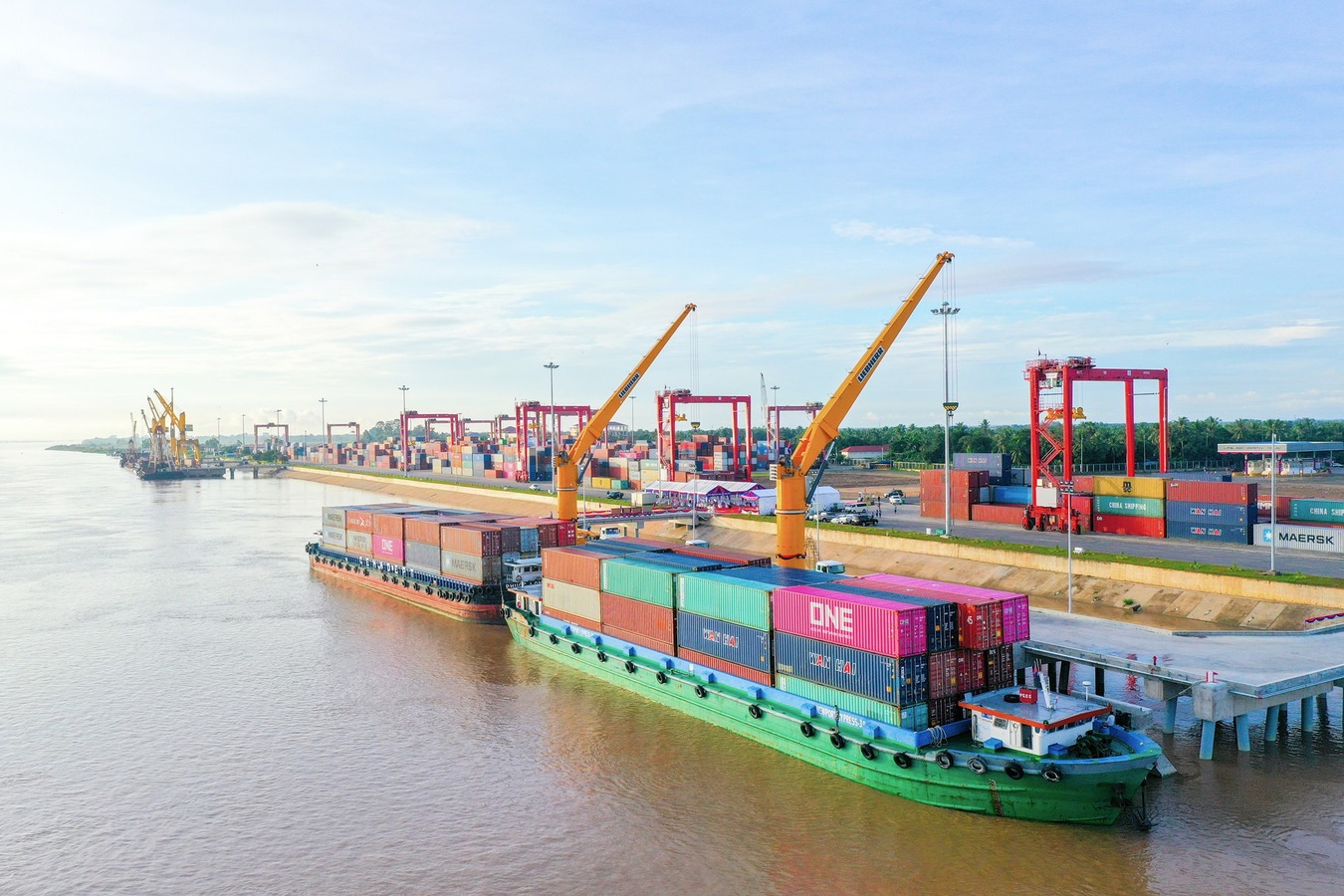
Growth in waterway transport activities helped the Phnom Penh Autonomous Port (PPAP) generate nearly $14 million in revenue in the first quarter of 2026, an increase of more than a third compared to the same period in 2025, while container throughput exceeded 160,000 TEUs (twenty-foot equivalent units).
According to PPAP’s 2025 annual report — released this week by the Cambodia Securities Exchange (CSX) -listed company — total revenue from operations and other services between January and March 2026 reached $13.9 million, up 34% year-on-year. Revenue from port operations amounted to $11.7 million (up 38%), revenue from port authority services reached $1.96 million (up 22%), while revenue from other services, including storage and land leases, totalled $238,538 (down 30%).
The report noted that in the first quarter, cargo and fuel throughput at PPAP reached 1,468,638 tonnes, an increase of 13.35%. Container throughput totalled 162,242 TEUs (up 33.61%), with 1,001 cargo vessels docking (up 11.59%). Passenger boats numbered 153 (up 8.52%), while total passenger traffic reached 15,886 people, an increase of 2.33%.
Chea Chandara, president of the Logistics and Supply Chain Business Association in Cambodia, told The Post that progress in cargo transport through the port has remained consistently positive and is expected to accelerate further once the Funan Techo Canal project becomes operational. He explained that the approximately 180-kilometre canal will connect river transport to seaports, passing through Kandal, Takeo, Kampot and Kep provinces.
“Cambodia’s economic growth and rising domestic production have steadily increased import-export flows. In general, waterway transport offers several advantages, including lower costs, less congestion compared to road transport and the ability to carry larger volumes,” he said.
In 2025, PPAP recorded total revenue of $50.31 million, achieving 109.13% of its annual target. Compared to 2024, this represented an increase of $8.72 million, or 19.19%.
Most imports through PPAP consist of construction materials, household goods, food and beverages, and raw textiles. Meanwhile, exports include textile products, household items, construction materials and electrical goods.